What are the effective strategies for building internal momentum around low-carbon procurement?
By the end of this lesson, participants will be able to:
- Build internal alignment to support low-carbon procurement
- Use demand signals to influence supplier behavior and drive market formation
For many companies, Scope 3 emissions make up a majority of their climate footprint. As voluntary and regulatory requirements converge, the pressure is mounting for greater transparency, sector-specific detail, and measurable reduction outcomes. Cutting these emissions will require businesses to stimulate the demand for low-carbon products and make them available and accessible. Strong buyer demand can unlock new supply, reduce cost curves, and scale low-carbon production. But this requires strong internal alignment and clear tools to engage internal stakeholders effectively.
To build internal momentum, procurement teams can take the following steps:
1. Gain senior leadership support by positioning low-carbon procurement as a critical lever for achieving corporate sustainability and net-zero goals.
Depending on your company structure, senior leaders may not have the context for why being at the forefront of sustainable innovation matters. By providing company executives with the knowledge that they need to make informed decisions, you help them best position the company against future risks and regulatory changes.
RMI’s Catalytic Procurement report outlined key roles and benefits companies can play in creating differentiated, low-emissions commodity markets. To support you in making the case to senior leadership, we have distilled the key points and provided a template to help frame Scope 3 management in clear business terms.
2. Advocate for an effective governance structure.
An effective internal governance structure integrates decarbonization efforts across business functions, empowering procurement teams to prioritize low-carbon options and directly contribute to sustainability goals. The three main governance models are centralized, decentralized, and distributed. Although each approach has its own advantages and disadvantages, the decentralized and distributed structures tend to be more beneficial in building internal momentum. Because they emphasis collaboration across corporate teams, they enable climate solutions to scale at a faster rate.
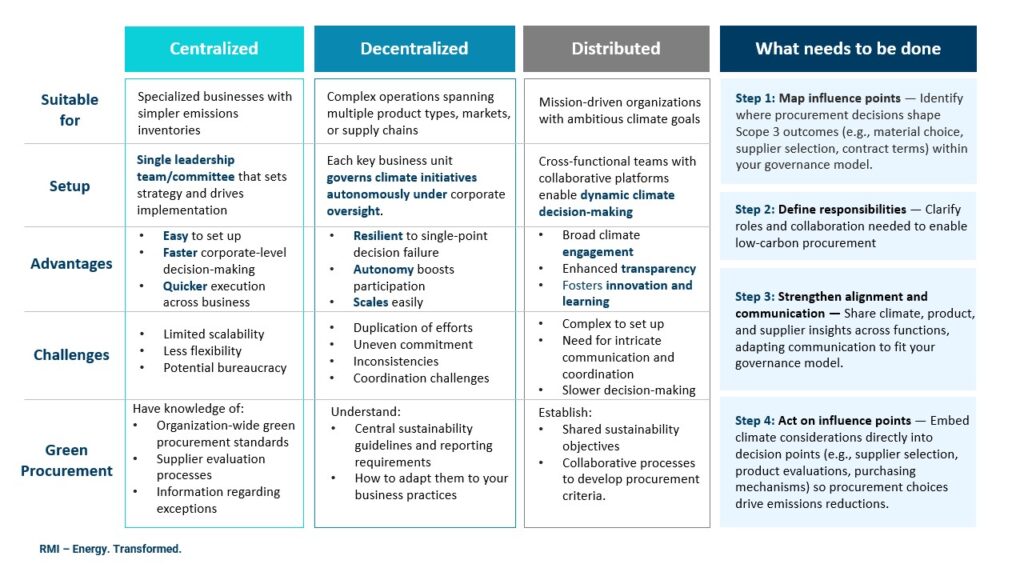
In a distributed governance model, low-carbon procurement is a shared responsibility across departments. While the procurement team may oversee supplier engagement and contracts, the sustainability team sets the low-carbon criteria and verifies claims. The operations team may oversee ensuring that products meet technical standards, and the finance team factors carbon costs into purchasing decisions. This collaborative approach ensures that sustainability goals are being embedded consistently across all purchasing activities while leveraging expertise from multiple functions.
Advocating for a distributed model is valuable, but even if you can’t change your organization’s governance structure, procurement can still play a stronger role by focusing on what each setup enables. Across all models, incremental steps can build momentum: map where procurement decisions influence Scope 3 outcomes, clarify roles and collaboration for low-carbon procurement, strengthen alignment by sharing climate and supplier insights across functions, and embed climate criteria into supplier selection, evaluations, and purchasing mechanisms. In a centralized model, you can help drive clarity by applying consistent standards; in a decentralized model, you may improve coordination between business units to align procurement considerations and evaluation criteria; and in a distributed model, you can help increase transparency through knowledge sharing and open reporting.
Below, you can find a case study describing how a distributed approach can help drive climate action.
Case Study – Driving Climate Action Through Distributed Governance
One company’s internal momentum for Scope 3 decarbonization was catalyzed by climate-ambitious leadership that championed a distributed governance model. This model integrates formal decision-making structures with informal cross-functional networks to drive emissions reduction collaboratively across the organization.
- Distributed Ownership: Scope 3 responsibilities are allocated across key departments — sustainability, engineering, and industrial operations — each owning specific emissions levers and meeting regularly to set up shared objectives. A Sustainability Sync Forum convenes monthly to align business cases with input from the procurement and finance departments. This forum operates with structured agendas and terms of reference, where each department has equal decision rights and a veto mechanism to ensure alignment and shared accountability.
- Cross-Pollinated Sustainability Team: Many team members in the central sustainability department have worked at business units like supply chain, operations, and engineering. This model increases contextual fluency and trust, allowing the team to bridge departmental priorities, identify shared value opportunities, and help break silos.
- Effective Informal Networks: Sustainability focal points are embedded within major departments, forming an informal peer network that meets regularly to surface risks, share quick wins, and escalate issues to the Sync Forum.
- Accountability and Incentives: Progress is supported by both internal incentives (e.g., internal sustainability conferences, storytelling of success, and peer recognition) and external ones (e.g., linking leadership bonuses to carbon targets). A target-based internal carbon price also informs co-investment decisions with suppliers, reinforcing the financial logic for shared action.
Learning from this company’s example, procurement staff can start identifying opportunities to improve setup, communication, and collaboration to align departments on shared Scope 3 ownership. They can also formalize collaboration through clear terms of reference and decision-making protocols.
3. Take progressive steps to embed climate action into procurement strategy
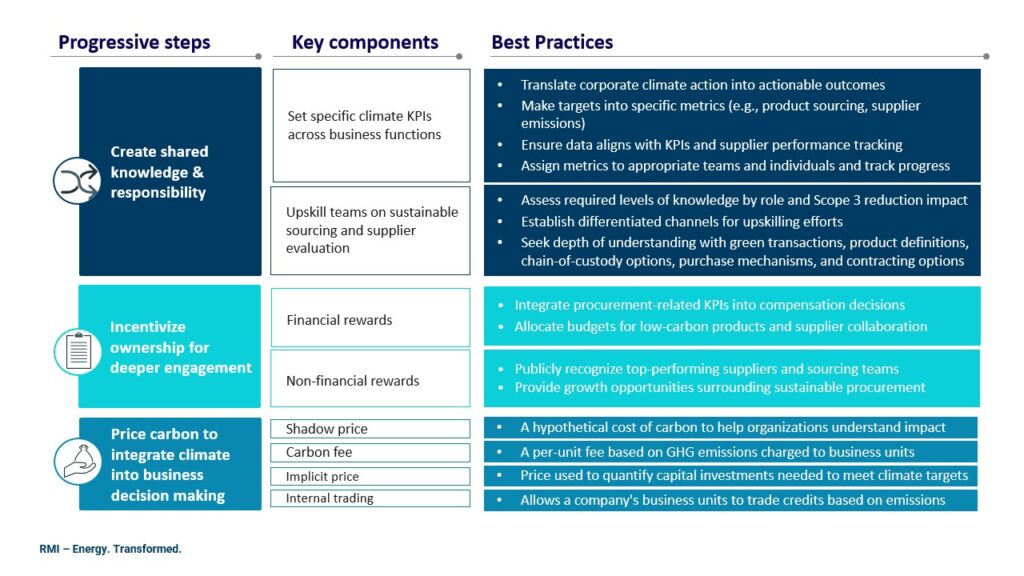
To sustain momentum, procurement teams can adopt enabling approaches that integrate climate action directly into sourcing. These progressive steps build on each other to move an organization from awareness to action:
- Create shared knowledge and responsibility: Establish the foundation for aligned decision-making by building understanding of climate targets and ensuring alignment across procurement decisions.
- Incentivize ownership: Include climate criteria into supplier engagement and employee performance to drive accountability and encourage everyone to take responsibility.
- Price carbon into procurement decisions: Embed climate considerations directly into financial decisions, making low-carbon choices a core part of business operations.
The Exhibit below shows how to apply each approach and helps you select the ones most equipped for your organization.
Activity – Mapping your internal momentum plan for low-carbon procurement
Step 1. Secure leadership buy-in:
- What is our strongest business case for low-carbon procurement?
- Which senior leaders need to champion this and how will we engage them?
- What quick wins could we use to demonstrate value?
Hands-On Practice: Use our template and your answers to the reflection questions to create your own pitch document. Make sure it explains your business case, is directed to the right people at your company, identifies key champions, and highlights quick wins.
Step 2: Strengthen governance by clarifying responsibilities and who to engage internally:
- Governance structure: Do we have a governance model? If so, is it effective? What is my role in the structure?
- Collaboration model: Who coordinates between departments and defines priorities? What can I do to facilitate cross team collaboration on low-carbon procurement?
- Policy setting and decision authority: Who defines low-carbon procurement standards? Who has the final say on procurement criteria and supplier selection?
- Data ownership: Who collects, validates, and shares supplier emissions data?
- Budget control: Who approves spending on lower-carbon materials?
Hands-On Practice: To advocate for an effective governance structure, draft or refine a clear framework that defines roles, responsibilities, and decision-making processes, ensuring strong collaboration and accountability in your company.
Step 3: Embed climate action in business strategy:
- Which progressive steps has your company already taken to integrate climate action into its business strategy?
- Where are the most critical gaps in your company’s current approach and what actions can address them?
- Which areas do you have influence or decision-making authority over and how can you leverage this to drive progress?
Hands-On Practice: Build on the progressive steps outlined in the lesson to create a roadmap for advancing your company’s climate goals. Reflect on which progressive steps have already been embedded into procurement processes, and which ones still need further consideration. Identify critical gaps in your procurement approach (e.g., lack of supplier data, limited incentives for low-carbon solutions) and outline targeted actions to close them. Consider where you hold decision-making power (e.g., supplier selection, contract negotiations) and define how you can leverage that authority to accelerate climate action through purchasing decisions.
By taking action to align internally around sustainability, you can position your company to be at the forefront of emerging low-carbon procurement opportunities.
Click the green Mark Complete button below to move on to the next lesson.